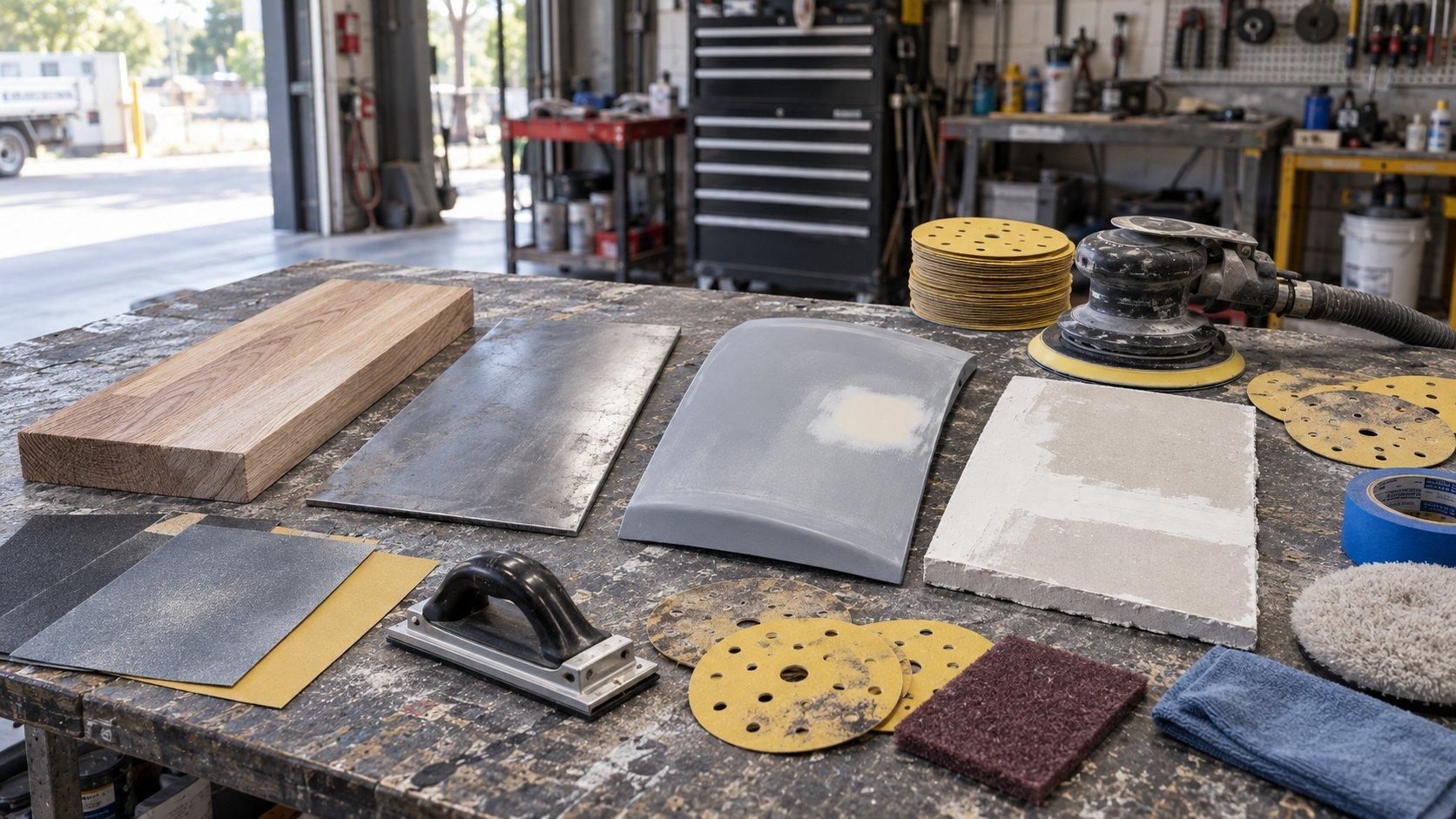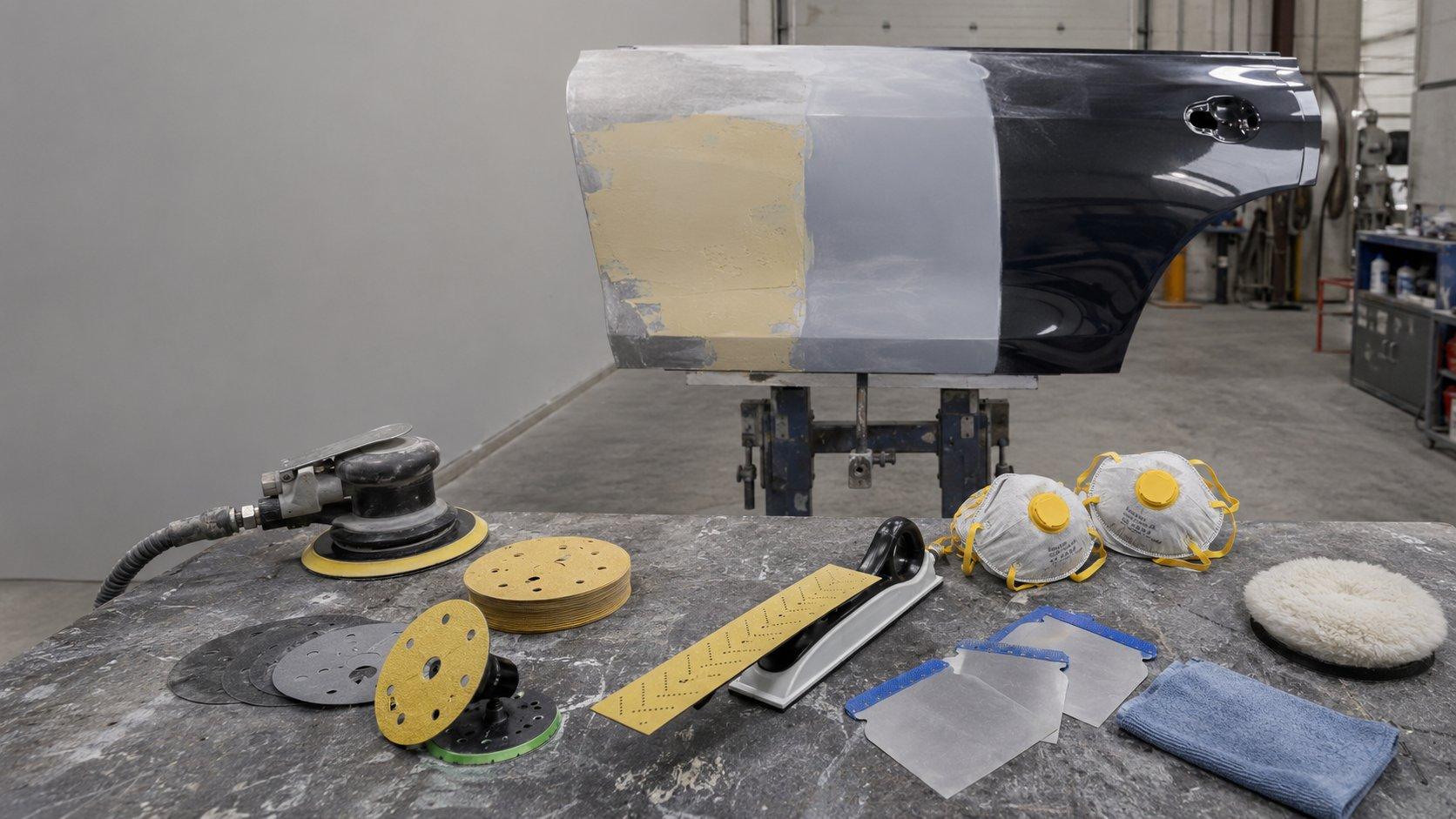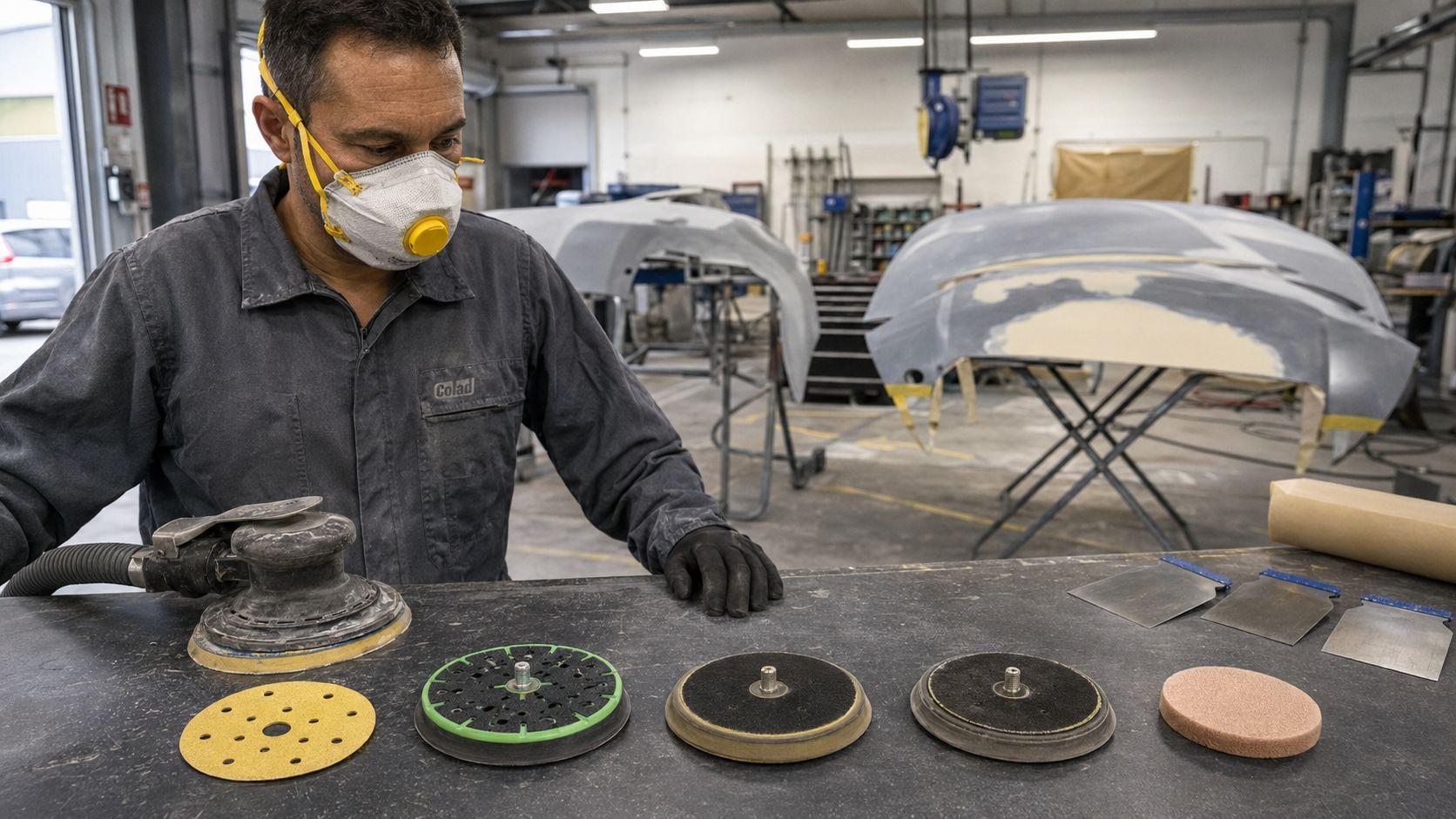
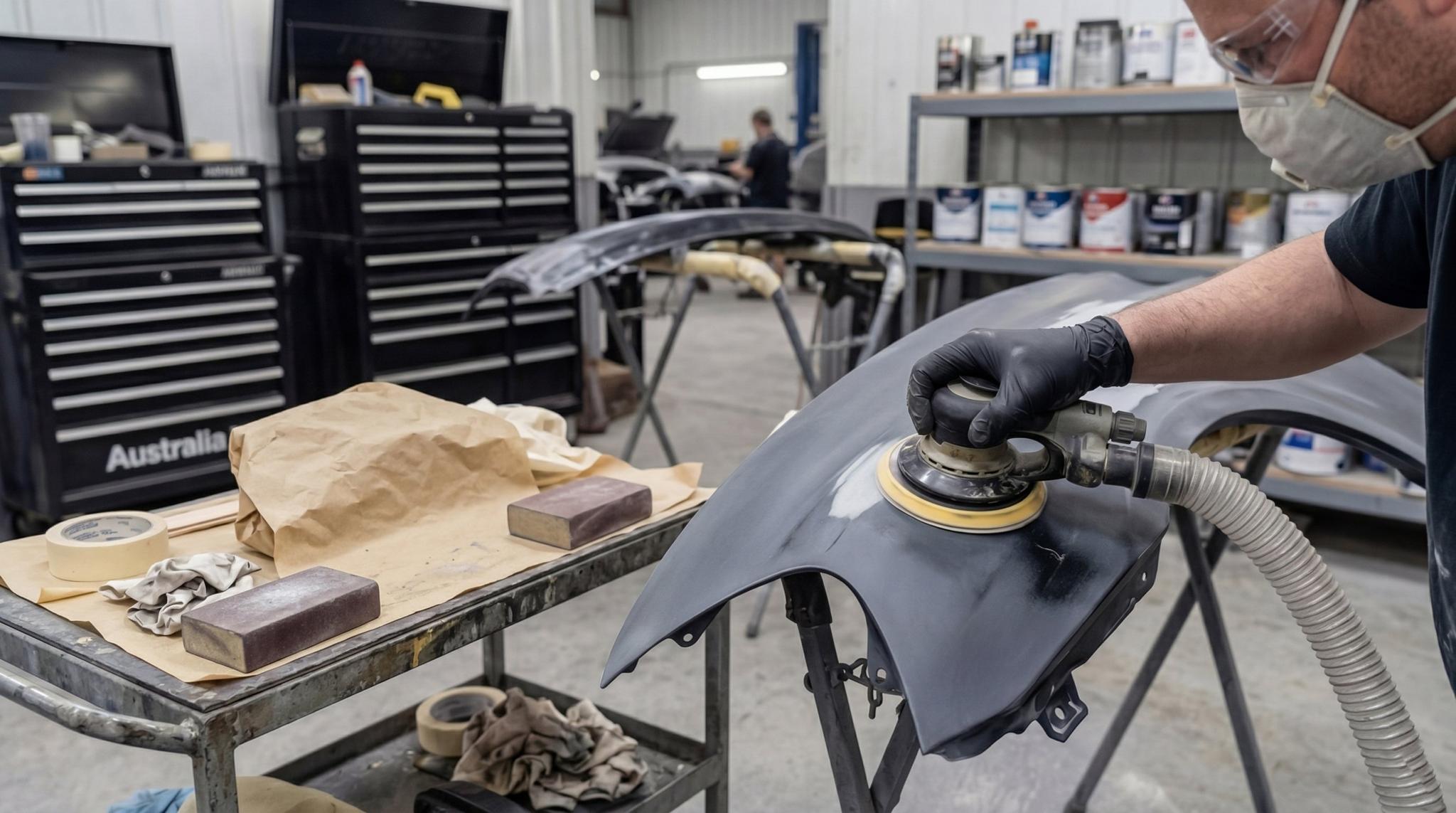
If you want one 150mm disc system for automotive refinishing in Australia, buy around the stage of the job, not the marketing claim on the box. For most panel and prep work, that means coarse ceramic 15-hole discs for body filler and fast stock removal, mid grits for feathering and primer work, and finer film-backed or fine ceramic discs for scratch control before colour and for clear-coat correction.
This guide replaces our older separate posts on body filler discs, 15-hole comparisons, hole-pattern buying guides, and ceramic-vs-aluminium-oxide comparisons. Use the sections below when you need a fast answer on body filler, primer, clear coat, disc materials, or hole patterns.
Quick Answer
| Repair stage | Best disc setup | Common grits | Why it works |
|---|---|---|---|
| Body filler knock-down | 150mm ceramic hook-and-loop disc | P60-P80 | Fast cut and better life when filler dust starts loading cheaper discs |
| Filler refinement and feathering | 150mm ceramic or film-backed disc | P120-P180 | Removes coarse scratches and tightens panel shape before primer |
| Primer surfacer sanding | 150mm 15-hole or multi-hole disc with extraction | P240-P600 | Keeps dust moving, helps scratch consistency, and reduces clogging |
| Clear coat denib and defect correction | Fine finishing disc or wet-and-dry sheet | P1500-P2000+ | Controlled defect removal before compound and polish |
| All-round workshop buy | 15-hole 150mm ceramic range plus matching pad | P80, P150, P180, P320, P600 | Covers the grits most prep bays actually burn through |
The main buying rule is simple: match the disc to the sanding stage, then match the hole pattern to the pad and extraction you already run. If you get those two calls right, the rest of the buying decision becomes much easier.
Body Filler
For most filler work, the safest starting point is a 150mm ceramic disc in P60 to P80, then P120 to P180 to remove the coarse scratch and tighten the repair. 3M Australia's small damage repair SOP is still a good sanity check here: initial prep at 80 grit, block-sand filler at 80, then step to 150 before feathering with 180.
That lines up with what busy workshops care about in practice. You need a disc that keeps cutting while the filler is throwing dust, but you still need enough control that the panel does not turn into a wavy, overheated mess.
.png)
What matters most on filler:
- Ceramic grain is usually worth the extra buy price if filler sanding is a daily job.
- Open coat or anti-load surfaces buy you more usable life before the disc starts rubbing instead of cutting.
- A DA makes the job faster, but a proper block still tells the truth on flat panels.
- Guide coat is cheap insurance. If you skip it, you are guessing.
A practical filler sequence for most repair work:
- P60-P80 to knock filler down and establish shape.
- P120-P150 to remove the coarse scratch.
- P180 to feather and tidy the repair edge.
- P240-P320 only after the shape is already right.
If a disc is smearing filler, loading immediately, or leaving random marks, the problem is usually one of four things: the filler is not properly cured, extraction is poor, the disc is worn out, or the operator is leaning on the sander too hard.
Primer and Clear Coat
Primer
Primer sanding is where dust extraction and scratch consistency start mattering more than brute cut speed. Once the repair is shaped, most workshops want a disc that keeps the surface clean, leaves a repeatable scratch, and does not force a bunch of extra cleanup later.
For dry primer work, 15-hole and multi-hole systems are the easiest win if the pad matches and the vacuum is doing its job. 3M's collision-repair guidance repeatedly ties cleaner dust flow to a more consistent finish and a cleaner bay. The official 3M Dry Guide Coat product guidance also calls out pinholes and scratches as the defects you are trying to expose before the next layer goes on.
Common primer-prep range:
- P240-P320 when you are refining the repair before primer.
- P400-P600 when you are sanding primer surfacer before colour.
- Finer than that only if the coating system calls for it.
.png)
Clear Coat
Clear coat work is not the same buying decision as filler and primer. At that point the brief is not "remove material fast." The brief is "remove the defect without creating a bigger problem."
For denibbing, texture correction, and local defect removal, the normal conversation is fine finishing discs or wet-and-dry sheets around P1500 to P2000 and above, followed by compound and polish. This is also where fresh discs, a clean backing interface, and disciplined pressure matter most. Deep random scratches in clear are almost always more expensive to fix than the disc you tried to save.
The short version:
- Use coarse ceramic when speed matters on filler.
- Use extracted 15-hole or multi-hole systems when consistency matters on primer.
- Use fine finishing abrasives when defect removal on clear matters more than stock removal.
Disc Materials
There is no single "best material" for every stage. There is a best fit for the stage you are in.
| Disc material | Best use | Strength | Watch-out |
|---|---|---|---|
| Ceramic | Filler shaping, heavy prep, high-throughput bays | Fast cut and longer life under heavy use | Higher upfront cost |
| Aluminium oxide | Lower-volume prep and general sanding | Lower box price and easy to source | Usually drops off sooner under hard filler work |
| Film-backed disc | Primer and scratch-sensitive stages | Better edge wear and cleaner finish control | Costs more than basic paper discs |
| Fine wet-and-dry finishing sheet | Denibbing and clear-coat correction | Controlled defect removal and finishing | Too slow for heavy prep |
If your bay sands filler and primer all day, ceramic is usually the smarter buy because labour time costs more than the extra disc price. If the work is occasional or mixed, aluminium oxide still has a place. If the goal is finish quality on primer and pre-paint stages, film-backed options earn their keep.
Hole Patterns
Hole pattern is not a minor detail. It decides how well the dust leaves the panel and how well the disc matches the pad you already own.
.png)
The practical difference:
- 15-hole discs are the safest trade buy if your workshop already runs 15-hole 150mm pads.
- 7-hole discs still make sense on older pad setups, but they are harder to justify if you are buying fresh and want stronger dust extraction.
- Multi-hole or net-style discs are best when extraction is the priority and the rest of the system is set up for them.
3M Australia's metal-shop guidance explicitly recommends multi-hole abrasives when the shop is trying to control sanding dust. That matters for more than cleanliness. Cleaner dust flow usually means less loading, fewer pigtails, and a more stable scratch pattern.
What buyers get wrong most often is treating the hole pattern like a separate decision from the backing pad. It is not. Start with the pad you actually run, then buy the disc that matches it.
Buying Checklist
If you are standardising a 150mm disc system for a workshop, use this order of operations:
- Match the disc to the job stage. Keep coarse ceramic grits for filler and heavy prep, then separate out the finer primer and finishing stages.
- Match the hole pattern to the pad. Do not buy a 15-hole or multi-hole system on autopilot if the sander in the bay is set up differently.
- Stock the grits you actually burn through. For most prep bays that means the daily-use stack gets priority: P80, P150, P180, P320, and P600.
- Compare cost per usable job, not cost per box. A cheaper disc that loads early or needs more swaps is usually the more expensive workshop decision.
- Check dispatch, pack size, and repeat supply. Consumables only feel cheap until the wrong grit is out of stock on the day you need it.
Recommended SPX setup:
- SPX 150mm Ceramic Sanding Discs - 15-Hole - 60-80 Grit - 50 Pack
- SPX 150mm Ceramic Sanding Discs - 15-Hole - 120-1200 Grit - 100 Pack
- Apply for trade pricing
Workshop Proof
As of 17 April 2026, approved SPX review data for the two 150mm 15-hole ceramic disc packs totals 22 reviews averaging 4.82/5. Anonymous order data shows those two SKUs appeared in 7 orders across 4 distinct customers between 26 November 2025 and 15 April 2026, with 3 orders landing in April 2026 alone.
That does not replace a product trial in your own shop, but it is a better proof signal than generic marketing copy.
"Really impressed with these discs. We run a joinery spray painting business and sand all day, every day, so we go through a lot of abrasives. These ceramic discs last noticeably longer than most brands and are comparable to 3M and Festool in performance. We're using far fewer discs than before, and they cut much faster, which has made a big difference to our workflow."
Bradley, verified purchase review on the SPX 150mm 60-80 grit ceramic discs
"Was using generic discs before and thought they were fine until I tried these. Way more consistent finish and they do not clog up halfway through a job."
Aaron M., approved customer review on the SPX 150mm 120-1200 grit ceramic discs
Technical References
These are the main technical references behind the grit and process guidance above. Always confirm the final grit and prep sequence against the filler, primer, and topcoat system you are actually spraying.
- 3M Australia: Small damage repair SOP
- 3M Australia: Metal panel and collision repair resources
- 3M Australia: Dry Guide Coat 09560
- 3M Australia: Abrasives for collision repair
- 3M Australia: Heavy duty truck repair resources and SOPs
Final Word
If you want fewer sanding problems in automotive refinishing, simplify the system. Keep the coarse ceramic discs for filler and fast stock removal. Keep extracted 15-hole or multi-hole discs for primer and repeatable prep. Keep fine finishing abrasives for clear-coat correction. Buy the pad, hole pattern, and grit stack as one system instead of as random boxes.
That is how you stop blog-post-level confusion from turning into workshop-level waste.
Featured Products From This Article
Quick picks already referenced in this guide.
Compare SPX with other abrasive brands
Picked your grit range and still deciding on a brand? These honest, side-by-side guides weigh SPX against the names most panel shops already run — covering cut, fitment, dust extraction, and real cost per job.
- SPX vs 3M sanding discs — ceramic cut against 3M Cubitron, plus the cost-per-job maths.
- SPX vs Mirka sanding discs — 15-hole versus net dust extraction, without the tool lock-in.
- SPX vs Indasa sanding discs — two value brands compared on cut and supply.
- SPX vs Norton abrasives — refinish focus versus a broad industrial range.
- Best Mirka alternatives in Australia — dust-managed sanding on the sanders you already own.